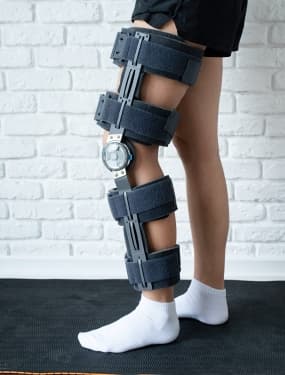
Custom bracing is the assessment, fitting, and supply of orthopedic supports designed to protect an injured or unstable joint, and it's a service we provide directly at our Brampton clinic alongside your treatment plan. The right brace can take pressure off a healing structure, add stability to a joint that gives way, and give you the confidence to stay active while your body recovers.
What happens at a bracing assessment?
A bracing appointment starts with understanding what the joint needs protection from: post-surgical stability, ongoing ligament instability, arthritic changes, or protection during a return to sport. Your therapist examines the joint, considers your activity level and goals, and determines whether an off-the-shelf brace or a custom-fitted option is the better fit. From there, you're professionally fitted so the brace sits correctly, moves with the joint the way it should, and actually delivers the support it's designed for. No referral is needed to book a bracing assessment: you can call 905-794-8003 directly.
How do you know if you need a custom brace versus an off-the-shelf one?
Off-the-shelf braces work well for many everyday situations, offering general support at a lower cost. Custom bracing becomes worthwhile when a joint has more specific instability, when a standard brace doesn't fit properly due to your anatomy, or when you need a higher level of protection during demanding activity or sport. Your therapist will walk you through the trade-offs during your assessment rather than defaulting to the most expensive option, so you get a brace that actually matches what your joint needs.
When is bracing part of the plan?
Bracing often comes up during recovery from ligament injuries such as ACL or MCL tears, as added support following joint surgery, or as ongoing management for arthritic or chronically unstable joints. It's also common for people returning to sport who want extra protection against re-injury while their strength and control are still rebuilding. Bracing is frequently paired with our physiotherapy and post-surgical rehab programs, since a brace supports the joint mechanically while therapy addresses strength, control, and the underlying cause of instability.
Who is custom bracing for?
We fit braces for a wide range of patients: athletes managing knee or ankle instability, people recovering from surgery who need extra protection in the weeks after their procedure, and older adults managing arthritic joints who want more confidence and less pain during daily activity. Whatever the reason, fit matters more than most people expect: a poorly fitted brace can shift during activity, cause skin irritation, or simply fail to provide the support it's meant to. That's why we treat bracing as a clinical service, not just a retail purchase. Patients from Brampton East, McVean, and Castlemore find our McVean Drive clinic convenient for both the initial fitting and any follow-up adjustments, with evening and Saturday appointments available for those balancing work and recovery.
How does a brace fit into your broader recovery?
A brace is rarely the whole solution on its own. It's usually one part of a bigger plan. Early after an injury or surgery, a brace can limit movement in directions that stress the healing structure while still allowing safe activity in others. As you get stronger and your control improves, your therapist may adjust the level of support the brace provides, or move you toward less restrictive bracing as you no longer need the same degree of protection. The goal is never to keep you dependent on a brace longer than necessary. It's to bridge the gap between injury and full, confident function. Your therapist will periodically reassess whether your current brace still matches where your joint is at, and will talk you through when it makes sense to step down your level of support.
Before you book
Frequently asked questions
How long does a custom brace take to fit?
Timing depends on the type of brace and whether it needs to be custom-made versus fitted from stock sizes. Your therapist will give you a realistic timeline for your specific situation during your assessment.
Do I need a referral to get fitted for a brace?
No referral is required: you can book a bracing assessment directly by calling 905-794-8003.
Is bracing covered by insurance?
Bracing is often covered, in whole or in part, by extended health plans, and we can also bill directly for braces related to WSIB or motor vehicle accident claims. Bring your insurance or claim details to your appointment and we'll help confirm what applies to you.
Can I combine bracing with physiotherapy?
Yes, bracing and physiotherapy work well together, particularly during ligament recovery or after surgery, where the brace provides mechanical support while your treatment plan rebuilds strength and control around the joint. Braces can also need adjustment over time as swelling changes or strength improves, so your therapist checks the fit at follow-up visits and lets you know if a refit makes sense.
Conditions treated
- Knee instability
- Ligament injuries (ACL, MCL)
- Post-surgical support
- Chronic joint pain
- Osteoarthritis
- Ankle instability
Our approach
- Condition assessment
- Anatomical fitting
- Medical-grade materials
- Activity-level customization
What to expect
- Better joint stability
- Less pain during activity
- Lower re-injury risk
- Able to stay active